
A postcard recalling a strike. Could we imagine something like this nowadays?
The huge demand for coal necessary to supply the furnaces of old glass factories, explains the presence of many glassworks in mining areas.
In the French town of Carmaux, near Toulouse, this glass-coal symbiosis can be found. Important strikes took place there at the end of the 19th century. Something similar happened in the Wallonia region of Belgium. For example, the village of Jumet already had glass furnaces in 1621, and it was this industry which accelerated the development of coal mining in Belgium.
Today there are few remnants of the era of great Belgian glassmakers. Val Saint Lambert is one of those rare examples. As for is mines, Belgium experienced their closure during the 1960’s, a progressive closure culminating in 1992 with the closure of its last coal mine. This ended a chapter in the history of a country, let’s not forget, that was a founder member of the European Community of Steel and Coal ( ECSC).
Belgium had ended the Second World War with a huge deficit in manpower necessary to exploit its vast coal reserves. Italy however had come out of the war in a state of great poverty and lacking in raw materials. In this context, the Italo-Belgian protocol was signed. This protocol organised the exchange of Italian workers for Belgian coal, with the arrival on Belgian soil of 140.000 Italians during the following years. The workers were obliged to work for at least one year in the coal mines, otherwise risking a prison sentence.
The Charleroi Glass Museum is actually located at the Bois du Cazier, a UNESCO World Heritage Site, emblematic setting for the mining tragedy in 1956 which killed 262 miners( 136 of them Italians) : the Marcinelle catastrophy.
Only 20 kilometers from Charleroi, in Manage, factories like Scailmont produced authentic works of art during the first decades of the 20th century. The concentration of glassworks in Manage earned it the nickname of “Cité du Verre”.
We are now in 1910, mining is booming in Belgium and here in the village of Manage, with only 5.000 inhabitants, a group of men and boys are posing proudly. They are glass cutters and they are on strike. The presence of children attracts our attention, but one has to remember that child labour was common practice at the time.
A twelve-hour working day was also normal. In fact one can read on a background poster: “La Fédération nationale des travailleurs du verre belges demande la suppression du travail de nuit“, enough of working day and night!
The reasons for protest were numerous, but it was the fight for associative freedom which led to this strike in 1910.
A complete summary of the facts can be found in the press of 1910, and the presence of no less than 400 glass workers is mentioned. In the November issue of the same newspaper, more details can be found about these strikes, with a clear reference to the lack of associative freedom and how bosses made the workers sign contracts containing illegal clauses, even according to the legislation at the time, which allowed them to sack the worker if he belonged to a union. Not only could the employer sack the worker, but he could also claim compensation in court.

The existence of a large strike fund destined to financially support the strikers, is proof in itself of the solidarity amongst the workers.
Another postcard found on Internet shows us a group of musicians formed by the Manage and Familleureux strikers.
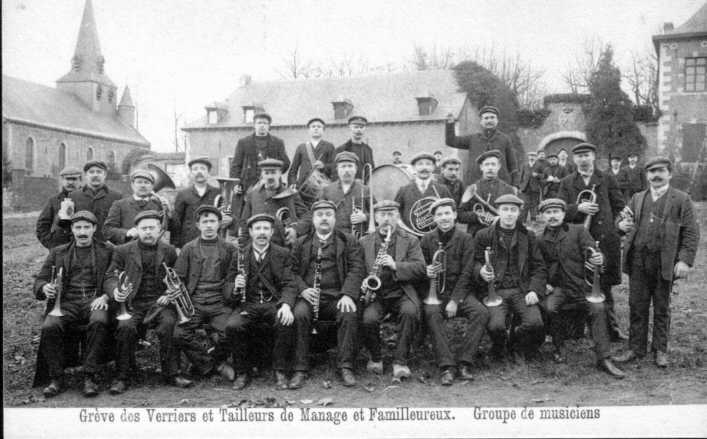
Searching on Internet, we note that in those days any worthy company had its own band. This was the case of the Cristalería Española (the Spanish Glassware Company).
These are not the only postcards that remind us of the Manage glass strikers. Here we can see them again:

It is interesting to note that the glass strikes in Manage certainly contributed to the popularity of one of the members of the strike committee: Jules Pétiaux, who I believe can be seen standing up on the first postcard, just below the letter “C” in Café and on the second postcard , holding a saxophone, the most Belgian of musical instruments. Pétiaux, a glass cutter, son of a glazier, a worker at Scailmont, married to a glass cutter, was elected Mayor of Manage in 1921 and remained in office until 1926.
Translated by Sue Dangotte
Great article